
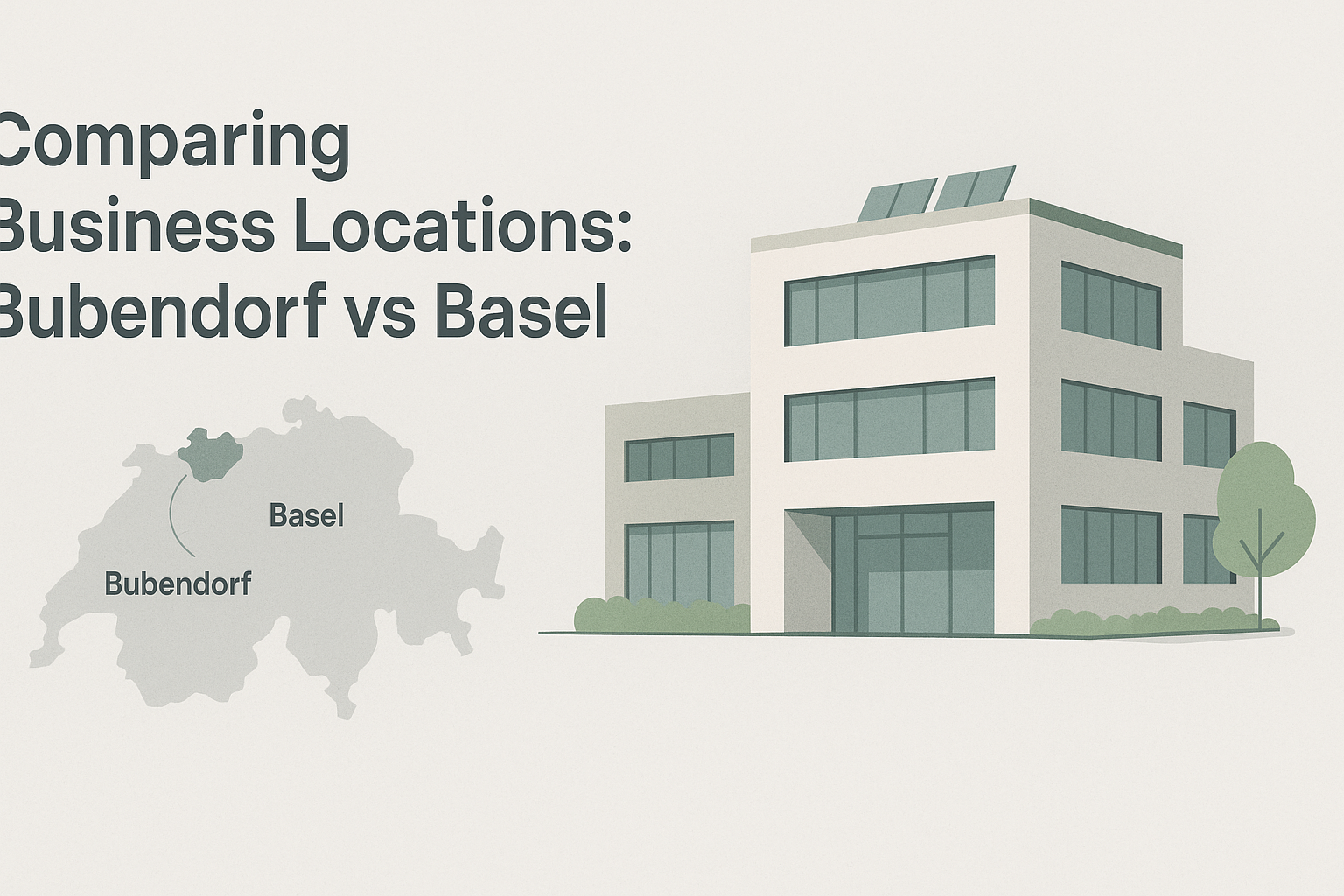
Comparing Business Locations: Bubendorf vs Basel for Office and Commercial Property Decisions in the Basel Region
For companies and investors assessing a business location in the Basel region, the comparison between Basel (as an international city) and Bubendorf (as a municipality in Basel-Landschaft) is less about “city versus countryside” and more about operating logic: access to talent and markets, transport connectivity, cost structures, planning certainty, and the quality of the built environment. K7 Center in Bubendorf sits directly in this decision framework as a commercial property option that benefits from proximity to Basel while operating within a distinct regional context.
Bubendorf is a municipality in the district of Liestal in the canton of Basel-Landschaft (Basel-Country), Switzerland, with a defined settlement footprint and a land-use profile that remains strongly shaped by forest and agriculture alongside a settled area for buildings, roads, and industry. These fundamentals matter because they influence how easily a location can accommodate long-term business activity and how predictably it can evolve over time. For a factual overview of Bubendorf’s geography, demographics, and transport connections, see Bubendorf (Wikipedia).
1) Regional context: why the Bubendorf–Basel comparison is increasingly relevant
Basel’s global reputation is closely tied to life sciences, headquarters functions, and cross-border market access. The broader “Basel Area” positions itself as a European commercial hub for life sciences, emphasizing the tri-national setting and a concentration of commercial talent. It also highlights the relevance of fiscal competitiveness and incentives for innovation-driven companies (including references to effective corporate tax rates and available support measures). For a representative summary of how the Basel Area frames these strengths, see Europe’s Life Sciences Commercial Hub | Basel Area.
At the same time, the business location Basel region is not limited to the city boundary. Companies often separate functions: client-facing and corporate representation in central Basel, and operational, technical, or support functions in well-connected regional nodes where office space can be configured more efficiently and scaled with less disruption. Bubendorf, within Basel-Landschaft, is one of those nodes—particularly relevant for firms that value predictable occupancy costs, practical commute patterns, and space planning flexibility.
In this context, K7 Center contributes to the regional supply of commercial property in Bubendorf by serving tenants and investors who want Basel proximity without relying exclusively on inner-city constraints. For background on K7 Center’s positioning, location and offering, see k7bubendorf.ch.
2) Core comparison factors: office requirements, transport connectivity, and economic anchors
Office demand is fragmenting: from one headquarters to multiple fit-for-purpose sites
Across Switzerland, office demand is increasingly shaped by hybrid work, project-based staffing, and the need to right-size footprints. This has two consequences for “office Basel” versus “office Bubendorf” decisions:
- Basel remains strong for brand visibility, proximity to major institutions, and premium central addresses; it is often the default for headquarters functions and customer-facing teams.
- Bubendorf is typically evaluated for operational efficiency: adaptable floor plans, a calmer working environment, and easier scaling when teams expand or reorganize.
This shift also supports flexible office strategies where companies combine a stable leased base with on-demand space for peak periods or project teams. When discussing flexible workspace concepts in the region, it is useful to reference established coworking models such as coworking.p201.ch, which illustrates how flexibility is being structured in practice (membership access, short terms, and shared infrastructure). For an additional view on evolving office concepts and workplace programming, the5thfloor.ch is a relevant example of how modern workspace expectations are changing (community, adaptable settings, and experience-led design).
Transport and commuting: accessibility is not only a “city” advantage
Location decisions depend on how reliably people and partners can reach a site. Bubendorf benefits from regional rail and bus connections. The municipality is served by the Waldenburg narrow-gauge railway with quarter-hourly service to Liestal, where onward connections link into the Swiss Federal Railways network with routes to Basel and other major Swiss cities. This is specifically noted in the transport description for Bubendorf in the Wikipedia article.
For employers, the practical difference is that commuting does not need to be city-centric to be efficient. Regional nodes with frequent connections can offer a stable “catchment” of employees across Basel-Landschaft and the wider Basel region—often with less exposure to inner-city congestion patterns and higher pressure on central infrastructure.
Economic anchors: why regional industrial strength matters to office and commercial real estate
Investors and corporate tenants often underweight the importance of anchor employers in smaller municipalities. Bubendorf’s economic profile includes a substantial secondary sector and a meaningful base of tertiary services. According to the municipality’s employment breakdown summarized in Bubendorf (Wikipedia), manufacturing and construction represent a large share of local jobs, which is relevant for the stability of demand for supporting services, offices, and supplier networks.
A concrete indicator of the region’s industrial and life-sciences gravity is the continued expansion of Bachem in northwestern Switzerland and the scale of investments tied to its Bubendorf site. In a company statement, Bachem reported that expansion at the Bubendorf site was progressing according to plan with an investment volume of about CHF 550 million and around 800 new jobs over the following three years, and it emphasized the strength of regional conditions such as skilled workforce and supplier networks. See Bachem expands presence in northwestern Switzerland (press release).
For commercial property decisions, the takeaway is not that every tenant is life sciences—but that the broader employment ecosystem supports demand resilience: services, logistics, technical consulting, and administrative functions tend to follow major employment centers and their supply chains.
3) Practical relevance for businesses: choosing “office Bubendorf” or “office Basel” by function
Companies rarely need a single answer for the whole organization. A structured way to decide between office space in Bubendorf and office space in Basel is to map the location to the function:
- Client-facing leadership, brand, and frequent in-person partner meetings: Basel often aligns well due to city centrality and perception advantages in certain industries.
- Operational teams, shared services, project groups, and growth units: Bubendorf can provide a more efficient platform where space planning is less constrained and where teams can scale without repeated relocations.
- Hybrid strategies: a stable leased footprint in one location combined with flexible coworking access for satellite work or temporary capacity (as reflected by models such as coworking.p201.ch).
For decision-makers, this approach reduces risk: the location choice becomes a portfolio of settings rather than a single “bet.” This is particularly relevant when workforce growth is uncertain, or when internal departments have different requirements for quiet focus, collaborative work, and external visibility.
Within Bubendorf, K7 Center can be evaluated in the same way—primarily as part of a deliberate “right location for the right function” strategy. Additional context and regional comparisons can be found through p201.ch, which is useful when considering how different commercial locations position themselves across the Basel region.
4) Long-term value perspective: stability, adaptability, and sustainability logic
For investors and corporate occupiers alike, long-term value in Switzerland increasingly tracks three fundamentals:
- Adaptability of the building: floor plates, technical capacity, and the ability to reconfigure space over multiple tenant cycles.
- Location durability: transport reliability, labor catchment, and resilience of the local economy.
- Sustainability expectations: not as a slogan, but as a compliance and cost factor (energy performance, operating costs, and tenant ESG requirements).
Basel has prominent examples of sustainability-led development, and the Basel Area promotion highlights a major project framed as a “most sustainable office building.” While that statement relates to a specific project in the Basel ecosystem, the broader implication is clear: sustainability expectations are moving from “nice to have” to baseline for many corporate tenants. See the sustainability reference in the Basel Area commercial hub overview.
For a sustainable office building in Switzerland to remain competitive over time, it must translate sustainability into operational outcomes: predictable ancillary costs, credible reporting readiness, and technical systems that support modern use patterns. For tenants, this reduces long-term occupancy risk. For owners, it supports retention and the ability to reposition the asset without structural overhauls.
From a portfolio perspective, K7 Center also sits within a broader context of real estate ownership and management capabilities. For investors and professional decision-makers who assess track record and operational competence across assets, it is relevant to view the wider portfolio at sitex.ch.
5) Regional positioning within Basel-Landschaft: what Bubendorf offers that Basel cannot replicate
Bubendorf’s positioning is shaped by its scale and land use. The municipality covers about 10.81 km² and includes substantial agricultural and forested land alongside a settled area for buildings and roads, which is a different spatial reality than central Basel. These characteristics matter because they influence development patterns, the feel of the working environment, and how business sites integrate with surrounding uses. These geographic and land-use details are summarized in Bubendorf (Wikipedia).
For regional decision-makers and investors, Basel-Landschaft also plays a strategic role in offering distributed employment locations that relieve pressure on the city core while keeping businesses close to Basel’s institutions and cross-border advantages. Bubendorf benefits from being within this corridor: connected to Liestal and Basel, yet operating with a regional planning and space profile that can suit stable, long-term occupation.
In practical commercial terms, this often translates into a clearer separation between “representative address” needs and “productive space” needs. Bubendorf supports the latter—without requiring companies to leave the Basel region’s talent and supplier network.
Conclusion: a functional comparison, not a binary choice
The most defensible comparison between Bubendorf and Basel is not framed as a competition but as a functional allocation of space. Basel offers international visibility, cluster density, and a well-documented life-sciences ecosystem. Bubendorf offers an operationally efficient business setting within Basel-Landschaft, supported by rail connections via Liestal and reinforced by regional industrial investment signals such as the continued expansion at the Bubendorf site referenced by Bachem.
For companies evaluating office space in Bubendorf versus office space in Basel, the strongest approach is to match the location to business functions, future headcount uncertainty, and the need for flexible capacity. For investors assessing commercial property in Bubendorf, the long-term lens should prioritize asset adaptability, sustainable operating logic, and the durability of the Basel region economy rather than short-term sentiment. In this framework, K7 Center can be understood as a regional commercial property option that complements—rather than imitates—the city’s role in the Basel region.