
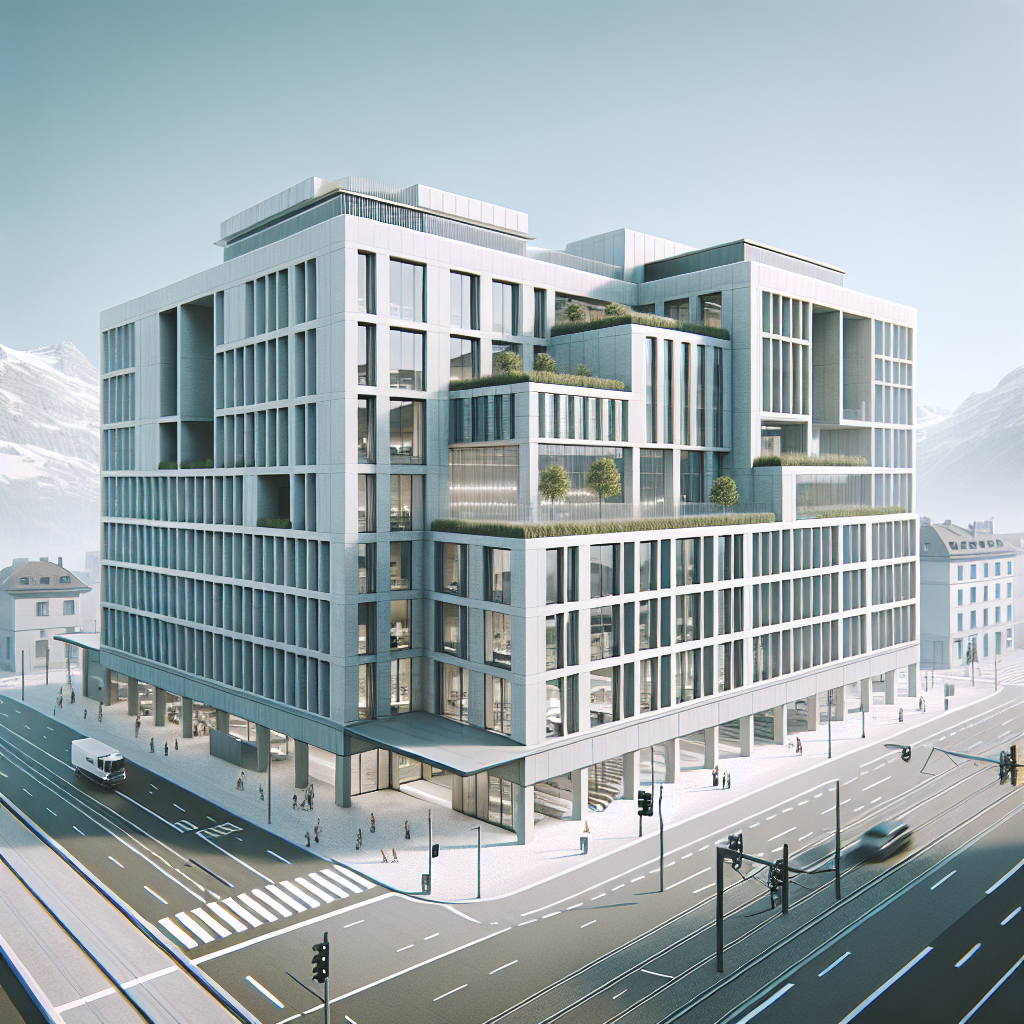
Infrastructure and Its Impact on Commercial Property Value in Switzerland: Why Connectivity Increases Demand
For corporate occupiers, investors, and public stakeholders in the Basel region, “infrastructure” is not a background variable—it is one of the clearest drivers of long-term location quality. In Switzerland, where zoning constraints and development pipelines are tightly regulated, connectivity can become a durable competitive advantage for existing assets. This is particularly relevant for commercial property in Bubendorf and the wider Basel-Landschaft corridor, where businesses weigh access to Basel’s economic engine against cost discipline and operational flexibility.
K7 Center in Bubendorf sits within this logic: a commercial location that benefits from regional mobility networks while remaining embedded in a cantonal environment known for predictability and planning stability. For readers comparing options in the Basel region, the site context is best understood within the broader positioning described on k7bubendorf.ch, as well as in relation to other established business hubs such as p201.ch.
1) Infrastructure as a Value Driver: The Mechanisms Behind Commercial Property Value Switzerland
Research consistently connects infrastructure development with real estate valuation through a few repeatable channels: improved accessibility, increased desirability, economic growth effects, and stronger investor confidence. A 2025 paper in the International Journal on Science and Technology summarizes this relationship directly, stating that improved transportation networks and utilities increase demand and support both price appreciation and rental yields (IJSAT: Impact of Infrastructure Development on Real Estate Property).
For decision-makers assessing commercial property value in Switzerland, these mechanisms matter because they translate into measurable outcomes: occupancy resilience, tenant retention, and lower re-letting friction. In commercial markets, the strongest “infrastructure effect” often shows up not as a one-time price jump, but as a sustained reduction in vacancy risk—especially when the asset matches what tenants currently prefer.
- Accessibility: faster, more reliable commutes and better regional reach expand the effective labor catchment area.
- Desirability: locations that are easier to reach become easier to lease; that tends to support rents and reduce incentives.
- Economic spillovers: infrastructure investment often correlates with job creation and cluster development, raising demand for nearby offices and services.
- Investor confidence: clear public investment signals reduce perceived long-term location risk, supporting liquidity and valuation stability.
2) Why “Flight to Quality” Makes Infrastructure Even More Important
Infrastructure is rarely evaluated in isolation. It interacts with what occupiers consider “quality.” In Switzerland, office markets are characterized by stable demand with modest vacancy in major centers, while tenant preference increasingly concentrates on modern, energy-efficient buildings—what many analysts describe as a “flight to quality” (Traverse International Finance: Swiss Commercial Property Investment Guide (2025)).
This matters for office space in Bubendorf because connectivity alone does not guarantee demand. Businesses typically want the combination of:
- Transport access that makes a location practical for staff, clients, and service partners.
- Workplace performance (building services, layout efficiency, and reliable digital infrastructure).
- Energy and ESG alignment that supports internal sustainability targets and cost predictability.
In other words: infrastructure is a demand amplifier. Where the building is outdated, accessibility may not compensate for shortcomings. Where the building aligns with tenant standards, accessibility can be the factor that turns a “good” option into a default choice.
3) Bubendorf and the Basel Region: Infrastructure as “Operational Reach”
Within the Basel region, many occupiers and investors think in terms of operational reach rather than municipal boundaries. Basel’s life sciences ecosystem, its tri-national logistics relevance, and its concentration of specialized services create consistent movement of people, suppliers, and knowledge across Basel-Stadt and Basel-Landschaft.
For businesses, the infrastructure question becomes practical: can a location reliably connect teams, customers, and partners to Basel while still offering manageable total occupancy cost? In that framing, Bubendorf functions as part of a wider economic geography—one where travel time reliability, road access, and public transport availability influence how “close” the site feels in everyday operations.
Flexible patterns, stable needs
Hybrid work has altered space planning, but it has not eliminated the office as a coordination tool. Swiss market commentary notes that firms often keep offices but adjust layouts and use models that accommodate flexible attendance rather than full daily occupancy (Traverse International Finance (2025)). Under these patterns, good infrastructure becomes even more important: fewer commuting days make employees less tolerant of difficult journeys, and companies become more sensitive to the experience of coming to the office.
When flexible workspace concepts are part of the strategy—project rooms, touchdown desks, or short-term expansion capacity—it can be helpful to look at established regional approaches such as coworking.p201.ch. The relevance for Bubendorf is not that every tenant needs coworking, but that modern occupiers increasingly want the option of flexible configurations without relocating.
4) Practical Relevance for Businesses: How Connectivity Shows Up in Day-to-Day Performance
Infrastructure impacts commercial property decisions in ways that are often underestimated because they do not always appear directly as a line item in rent. For business owners and corporate tenants, the most important impacts typically fall into four categories.
Recruiting and retention through commute quality
The practical commute experience influences recruitment—particularly for specialized roles where the labor market is regional rather than local. Better connectivity enlarges the talent radius and reduces the risk that the office becomes a constraint on hiring. Over time, that can translate into lower turnover and higher organizational stability, which is operationally valuable even if it is not accounted for in a real estate budget.
Client access and credibility
For client-facing companies, being reachable matters. A location perceived as “easy” reduces friction in meetings, service calls, and collaboration with partners. This is one reason why infrastructure often correlates with higher occupancy and pricing power in commercial assets—accessibility becomes part of the service level offered by the location itself.
Cost predictability and time efficiency
In Switzerland, where wage levels are high, travel time inefficiency has a real cost. Connectivity reduces unproductive time and improves scheduling reliability. For organizations managing multiple sites, infrastructure also simplifies inter-office travel and regional service coverage.
Space strategy: right-sizing without losing capacity
As companies refine their space needs, many aim to right-size while maintaining access to meeting space, collaboration areas, and future headcount flexibility. Modern workspace concepts—such as shared amenity floors and adaptable layouts—are becoming more visible, and examples of evolving office concepts can be seen in platforms like the5thfloor.ch. Here, infrastructure plays a supporting role: a flexible office strategy works best when the site is easy to reach on the days teams come together.
5) Long-Term Value Perspective: Infrastructure, Scarcity, and the Swiss Development Pipeline
From an investor perspective, infrastructure matters because it interacts with scarcity. Switzerland’s planning environment limits greenfield commercial development, and many expansions occur as mixed-use or redevelopment projects rather than unlimited new supply (Traverse International Finance (2025)). Where supply is constrained, existing assets in well-connected locations can benefit from a scarcity premium—especially if they meet modern tenant expectations.
CMC Global Estates notes that infrastructure projects underway in Switzerland are likely to “reshape the property value map,” suggesting that current prices in affected areas may not fully reflect future value impacts (CMC Global Estates: Infrastructure Impact on Switzerland’s Property Market). While their analysis is oriented toward broader market dynamics, the core implication for commercial assets is clear: committed infrastructure investment can strengthen long-term demand fundamentals.
For long-duration holders—pension-aligned capital, family-owned operating companies, or institutional owners—this tends to support three outcomes:
- Income stability: infrastructure-backed locations often show stronger tenant retention and more resilient leasing.
- Liquidity: assets that fit tenant demand and sit in accessible nodes are easier to transact, even in cautious markets.
- Capex efficiency: upgrading buildings in strong locations can be more value-protective than chasing yield in weaker, less connected submarkets.
6) Regional Positioning in Basel-Landschaft: Sustainable Office Building Switzerland Meets Real-Economy Logic
Basel-Landschaft’s positioning is frequently defined by its relationship to Basel’s economic core and by its ability to offer operationally efficient sites for companies that do not require a CBD address. In this context, infrastructure is the bridge between regional cost logic and metropolitan access.
Sustainability is increasingly part of that equation. Switzerland’s net-zero target by 2050 reinforces the direction of travel: tenants and investors pay greater attention to energy performance, while regulatory and financing environments increasingly reward efficient buildings (Traverse International Finance (2025)). For a sustainable office building in Switzerland, the link to infrastructure is practical: efficient buildings reduce operating costs, while good connectivity improves utilization and tenant satisfaction—together supporting long-term competitiveness.
K7 Center should also be seen in the context of established ownership and management approaches within the region. For readers interested in the wider real estate portfolio context behind similar Swiss commercial assets, sitex.ch provides a useful reference point. Portfolio-level consistency—maintenance standards, investment discipline, and tenant-focused operations—tends to matter more in Switzerland than short-term repositioning narratives.
Conclusion: Connectivity as a Measurable Component of Commercial Property Value
Infrastructure increases demand because it reduces friction—for employees commuting, for clients visiting, and for organizations operating across the Basel region. Research and market commentary align on the core point: improved accessibility and utilities raise desirability, support rents, and strengthen investor confidence (IJSAT (2025); CMC Global Estates).
For Bubendorf and the Basel-Landschaft business environment, the implication is straightforward. When an office location combines reliable regional connectivity with a building standard aligned to modern expectations—flexibility, efficiency, and sustainability—it becomes easier to justify as a long-term decision. In Swiss commercial real estate, that combination is often what separates stable occupancy from cyclical vacancy, and short-term savings from durable value.