
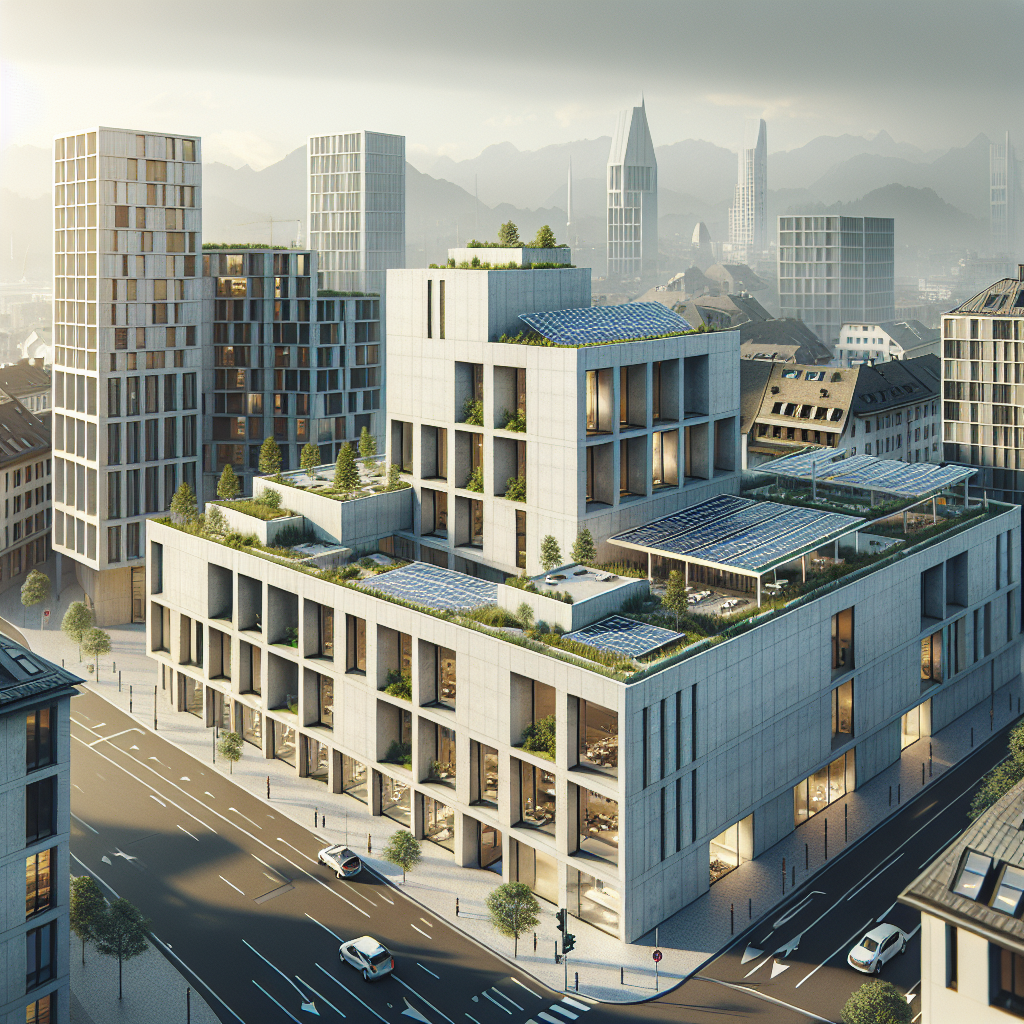
Photovoltaics in Office Buildings: Investment or Standard?
In the Basel region, commercial real estate is increasingly assessed through two lenses that used to be separate: location quality and energy performance. For office properties in Bubendorf and the wider Basel-Landschaft area, photovoltaic (PV) systems have moved from a “nice-to-have” sustainability feature to an infrastructure component that directly influences operating costs, tenant expectations, and long-term asset resilience.
K7 Center Bubendorf sits within this regional logic: a business location in the Basel economic catchment area where companies and investors evaluate not only accessibility and space efficiency, but also the predictability of utilities and the credibility of environmental performance. In that context, the question is no longer whether PV belongs on office buildings—but under what conditions it is a rational investment and when it becomes an emerging standard.
For readers comparing options for commercial property Bubendorf and the broader business location Basel region, basic context about the site and its positioning is available at k7bubendorf.ch.
1) PV economics in Switzerland: what the numbers actually suggest
PV investment decisions in office buildings typically start with a simple financial comparison: capital expenditure versus expected electricity savings and potential feed-in remuneration. A useful baseline for Switzerland is the cost range per installed capacity. A widely cited rule-of-thumb is that PV costs vary primarily with system size and complexity; a rough estimate for Switzerland is CHF 1,500–2,500 per kWp (kilowatt-peak), with larger systems generally benefiting from lower unit costs due to scale and installation efficiency (Alpvolt).
For larger commercial installations, more granular market reporting shows that turnkey prices can be significantly lower on a CHF/W basis. The IEA PVPS Switzerland report indicates typical ranges for large commercial rooftop systems (100–250 kW) at about CHF 1.0–1.5 per W, and for industrial rooftop systems (>250 kW) around CHF 0.9–1.1 per W (with lows reported near CHF 0.7/W in some cases) (IEA PVPS National Survey Report Switzerland 2021 (PDF)).
Two other Swiss realities matter for offices:
- Self-consumption is financially valuable. The same IEA PVPS report notes that self-consumed electricity can be worth 2–3 times more than typical feed-in remuneration, since it offsets retail tariffs rather than earning a lower injection tariff (IEA PVPS (PDF)).
- Swiss PV growth is already structurally embedded. Switzerland installed about 685 MWp in 2021 (up from 475 MWp in 2020), demonstrating that PV is no longer a niche technology but an accelerating part of the national energy system (IEA PVPS (PDF)).
For the photovoltaic office Switzerland discussion, this means that PV is increasingly evaluated like other building infrastructure upgrades: through lifecycle value, operating risk reduction, and tenant-fit—not only through headline ROI.
2) Sustainability as a leasing and investment parameter—not a branding exercise
In practice, PV supports two measurable objectives in office properties:
- Operating cost stability by lowering exposure to electricity price variability through on-site production and optimized self-consumption.
- ESG and carbon accounting alignment by reducing building-related emissions. PV’s value is not only financial; it also directly reduces a property’s carbon footprint and can support higher market acceptance of the asset, a point emphasized in Swiss market commentary (Alpvolt).
This matters for both corporate tenants and owners: the tenant increasingly seeks predictable service charges and credible sustainability performance; the owner seeks defensible market positioning and reduced “transition risk” as building standards tighten over time. In other words, PV contributes to a sustainable office building Switzerland profile in a way that can be verified in bills and reporting.
3) PV in the real world of office demand: the role of self-consumption and load profiles
Office buildings are structurally well-suited to PV self-consumption because their electricity use overlaps with solar production hours: lighting, IT infrastructure, ventilation, and cooling loads are typically strongest during daytime. This is important because Swiss market data underlines that self-consumption economics tend to dominate PV business cases (IEA PVPS (PDF)).
For multi-tenant office properties, the next step is organizational rather than technical: designing metering and allocation models that fit tenant structures. Switzerland explicitly allows collective self-consumption models (subject to conditions), making it possible for multiple users to benefit from a shared PV system without turning the project into an administrative burden if planned correctly (IEA PVPS (PDF)).
Flexible workspace and flexible energy use are converging
As flexible office Bubendorf and hybrid work models grow, electricity demand patterns can become more variable across tenants. This makes load management and transparent allocation more important. Flexible workspace operators and serviced-office concepts often pay closer attention to energy cost predictability because it affects “all-in” operating models. For examples of how flexible workspace concepts are organized and packaged in the region, see coworking.p201.ch.
Separately, modern office trend initiatives show that the workplace is also becoming more technology- and services-driven, which can increase daytime electricity intensity (screens, ventilation, cooling). For a local example of evolving office concepts and what “modern workspace” can look like operationally, the5thfloor.ch is a useful reference point.
4) PV as an asset strategy: long-term value perspective for owners and investors
From an investor’s standpoint, PV affects value through three channels:
- Net operating income (NOI): reduced landlord-paid electricity (where relevant) and/or improved competitiveness of service charge structures.
- Risk management: lower exposure to electricity price volatility and greater resilience under potential future regulatory constraints.
- Liquidity and exit appeal: buildings with credible sustainability systems can be easier to position in institutional capital markets, especially as due diligence increasingly scrutinizes energy performance and transition pathways.
There is also a broader Swiss policy trajectory: Switzerland’s Energy Strategy 2050 foresees a major PV scale-up, and the IEA PVPS report notes that annual installation rates need to increase further to reach long-term targets (IEA PVPS (PDF)). In commercial real estate terms, that implies PV becomes less of a differentiator and more of an expected feature—similar to the way high-performance building envelopes or modern HVAC systems became “standard” over time.
5) Regional positioning: Bubendorf and Basel-Landschaft in the context of commercial location choices
For decision-makers comparing office space Bubendorf with alternatives in the Basel area, PV should be seen as one component of a broader location and building-performance package. Basel-Landschaft combines industrial and life-science adjacency, access to Basel’s talent market, and increasingly sophisticated infrastructure expectations from corporate occupiers.
PV is particularly relevant in this environment for two reasons:
- Industrial and commercial buildings carry large rooftop potential. Nationally, while many installations are residential by count, industrial systems account for a disproportionately large share of installed capacity (IEA PVPS (PDF)).
- Tenant expectations converge across the region. Companies do not evaluate sustainability only in city-center addresses; they apply internal standards across their portfolios, including suburban and regional locations.
For those conducting a location comparison across the region, additional context can be found via p201.ch (as a contrasting location format) and k7bubendorf.ch (specific to Bubendorf).
6) Practical relevance for businesses moving into or operating in K7-type properties
For business owners and corporate tenants, the practical implications of PV in an office building are straightforward:
- Budgeting and cost allocation: PV can reduce exposure to rising electricity costs, particularly where self-consumption is optimized and transparent metering is in place.
- Reporting readiness: PV supports sustainability reporting with measurable kWh production and emissions reduction proxies.
- Operational continuity: while PV alone is not a backup power system, it contributes to an overall modern energy strategy when combined with sensible load management (and, where relevant, storage or contractual solutions).
For owners and institutional stakeholders, PV also interacts with portfolio strategy. K7 Center Bubendorf is part of a broader approach to commercial real estate stewardship in Switzerland; for an overview of the wider real estate portfolio context, see sitex.ch.
Conclusion: PV is trending toward standard, but investment discipline still applies
In Swiss office buildings, PV is increasingly close to “standard” status—driven by falling system costs, supportive self-consumption economics, and the normalization of sustainability requirements in corporate decision-making. Yet it remains an investment that should be evaluated with discipline: system sizing to the building load profile, clarity on self-consumption and billing models, and a realistic view of how PV supports asset resilience and tenant fit.
For commercial property in Bubendorf and the Basel region, the underlying logic is stable: buildings that can document lower operating risk and credible sustainability performance are better positioned for long-term occupancy and investment. PV contributes to that outcome when integrated as part of the building’s infrastructure strategy rather than treated as an isolated technology upgrade.