
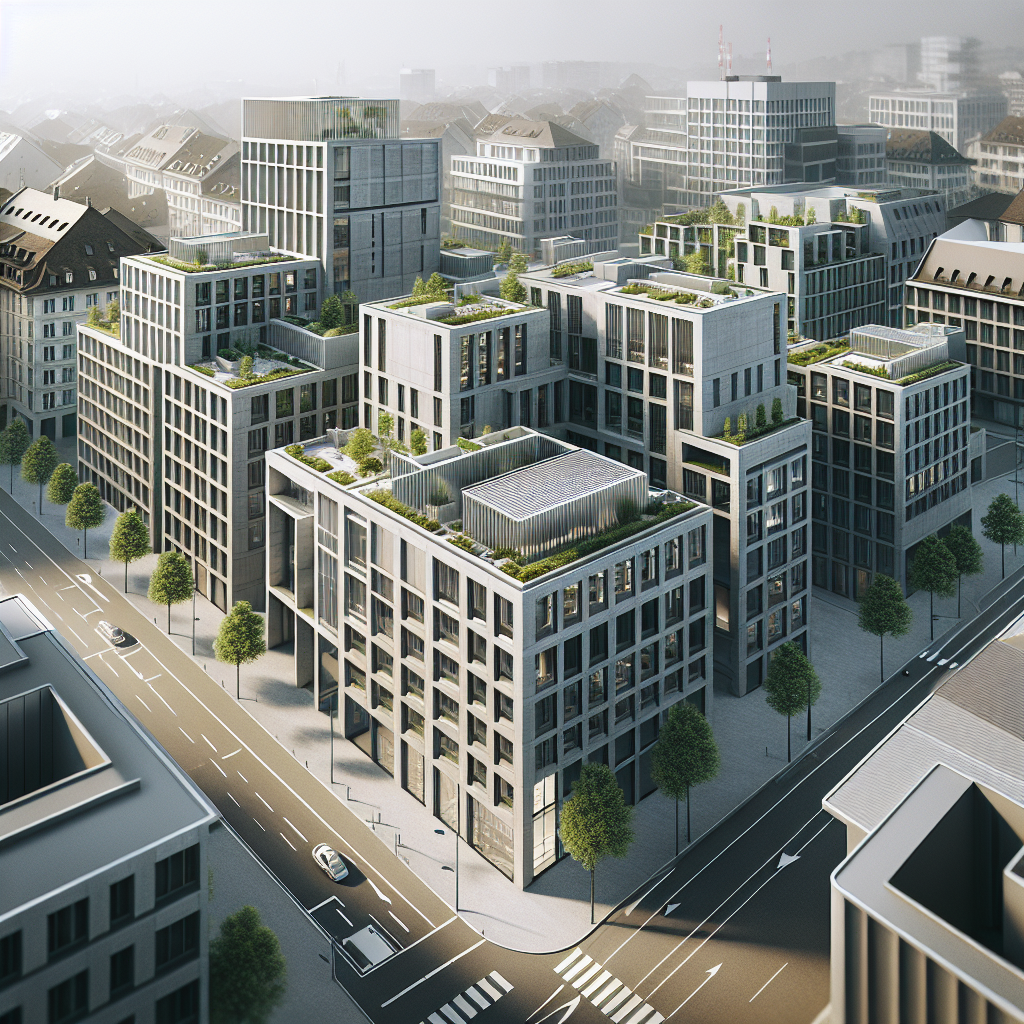
The Evolution of Commercial Real Estate in Basel-Landschaft: Stability, Quality and the Shift Toward ESG-Compliant Offices
Basel-Landschaft has long been shaped by a distinctive economic mix: internationally oriented life sciences and industry anchored in the Basel region, combined with a dense network of SMEs and service providers spread across the cantonal agglomerations. This structure influences how commercial real estate Basel-Landschaft develops—less driven by short-term cycles and more by long-term business fundamentals such as employment, infrastructure quality and the ability of buildings to meet changing operational requirements.
Within this context, Bubendorf has become increasingly relevant as part of the broader business location Basel region. It sits between metropolitan demand for high-quality offices and the practical need for efficient, well-connected premises outside the highest-cost city addresses. The K7 Center Bubendorf can be read as a local case example of how new commercial property concepts are aligning with market realities: a segmented office market, a stronger focus on building quality, and the growing expectation that offices contribute measurably to sustainability targets.
What is changing in Basel-Landschaft’s office market—and what is not
Two narratives have dominated office discussions in recent years: remote work and the presumed decline of physical workplaces. Yet Switzerland’s office market has proven more resilient than many forecasts suggested. Swiss Life Asset Managers notes that the predicted full relocation of office jobs into working from home “has not materialised,” and that demand remains stable because companies continue to require social working environments and collaboration spaces (Swiss Life Asset Managers, 2025).
This is consistent with a broader pattern now visible across the country: the office market is not uniformly “up” or “down,” but increasingly segmented. PwC describes the Swiss office market as “divided,” with central locations and modern, ESG-compliant offices benefiting from stable demand while peripheral, older properties remain under pressure (PwC Immospektive, 2025).
For Basel-Landschaft, that segmentation matters because the canton includes both highly connected nodes (close to Basel’s economic core) and locations that must compete more directly on quality, access and operating efficiency. In practical terms, office Basel region decisions increasingly revolve around three measurable questions:
- Can employees reach the office reliably and efficiently?
- Does the building support modern use patterns (collaboration, meeting density, hybrid schedules)?
- Is the property aligned with ESG expectations and operational cost predictability?
Quality and location: why the “middle” is becoming more strategic
Swiss Life Asset Managers highlights a principle that remains consistent over time: location and property quality are decisive. Central business districts perform better due to accessibility, familiarity and lower vacancy risk (Swiss Life Asset Managers, 2025). That does not mean that every business must locate in a CBD—particularly in a polycentric region like Basel. But it does mean that non-CBD locations must compete on “CBD-like” qualities: strong connectivity, professional building standards and a credible long-term use case.
Here, Bubendorf illustrates a broader evolution. For many occupiers, the question is not “city versus countryside,” but “friction versus efficiency.” A well-executed commercial property Bubendorf can reduce friction: simpler logistics, scalable space planning and a cost base that remains manageable while still connecting to Basel’s talent and client ecosystem.
Sustainability moves from “nice to have” to market filter
The shift toward sustainability is no longer primarily reputational; it increasingly functions as a market filter. PwC explicitly links resilience in demand to “modern, ESG-compliant office space,” while older existing properties in weaker submarkets face higher vacancy pressure (PwC Immospektive, 2025). This matters for both tenants and investors:
- For tenants, ESG-compliant buildings often mean lower transition risk (fewer surprises from future regulation), improved operating efficiency, and easier alignment with corporate sustainability reporting.
- For investors, ESG alignment can support liquidity and value stability in a segmented market, where “non-compliant” stock may require capital-intensive upgrades or face repositioning pressure.
In Switzerland generally, low-interest-rate expectations and stable yields keep institutional attention on well-located commercial assets, but with a stronger emphasis on quality and long-term letting prospects. Swiss Life Asset Managers points to stable income returns over the past decade for office properties (3.5%) and notes that investor interest remains evident in current yields (Swiss Life Asset Managers, 2025). The key is selectivity: sustainability and building quality increasingly define what is considered “core” over the next cycle.
For a sustainable office building Switzerland perspective, the practical consequence is clear: buildings that can document energy performance, operational efficiency and long-term adaptability will be easier to finance, lease and hold through changing market conditions than assets that rely only on headline rent comparisons.
Flexibility is evolving: from coworking as a niche to a portfolio tool
Flexibility in office use is also maturing. The market’s focus has shifted from the question of whether flexible workspace is legitimate to how it can be integrated intelligently—particularly for SMEs, project teams, and corporates seeking decentralised satellite options.
Swiss Life Asset Managers notes that companies still need physical space for meetings and social interaction, with many employers reintroducing attendance expectations (often limiting work-from-home to around two days per week) (Swiss Life Asset Managers, 2025). That pattern favours offices designed for collaboration rather than fixed individual desks—and supports the business case for flexible office Bubendorf concepts where scale can adjust without long reconfiguration cycles.
In the Basel region, flexible models are increasingly part of how organisations manage growth and uncertainty. For example, coworking.p201.ch illustrates how coworking and serviced office concepts can complement conventional leases—either as interim space, innovation hubs or as a decentralised option for teams that do not need daily CBD presence.
Modern workspace trends also include hybrid layouts, hospitality-style shared areas, and meeting-centric planning. Concepts such as the5thfloor.ch show how the definition of “office quality” is expanding beyond square meters to include experience, adaptability and collaboration infrastructure.
Practical relevance for businesses: what occupiers in the Basel region should evaluate
For business owners and corporate tenants, choosing office space Bubendorf or elsewhere in Basel-Landschaft is increasingly a decision about operational resilience. A useful framework is to evaluate a location and building through four practical lenses:
- Workforce access and reliability: commuting patterns, parking, and regional connectivity matter more in hybrid models, where employees may accept travel less frequently but expect it to be predictable.
- Space efficiency: buildings that support a mix of team zones, meeting rooms and quiet areas generally adapt better to hybrid work than purely cellular layouts.
- Cost stability: in addition to rent, occupiers should consider energy costs and the likelihood of future retrofit requirements.
- Brand and compliance alignment: many firms now need premises that align with sustainability commitments and reporting requirements.
When comparing options, regional occupiers often benchmark Bubendorf against other nodes in the Basel region. It can be helpful to view p201.ch and k7bubendorf.ch as reference points for different commercial micro-locations and building concepts within the wider region—each with distinct strengths regarding proximity to Basel, accessibility, and tenancy mix.
Long-term value perspective: why investors focus on “lettability” and adaptability
From an investor standpoint, the evolution of commercial real estate in Basel-Landschaft can be summarised as a shift from broad market exposure to asset-level selectivity. PwC’s assessment is relevant: returns for office properties are heterogeneous, and negative value changes are still observed particularly in peripheral office markets with older stock (PwC Immospektive, 2025).
JLL also notes that availability in Switzerland’s five largest office markets has increased since 2019, driven not only by working from home but also by a substantial wave of new completions (JLL Switzerland office market – 2026). This reinforces the importance of differentiation: where supply expands, “average” space competes harder, while buildings with clear advantages—modern standards, ESG alignment, and efficient floorplates—remain liquid.
In that context, long-term value correlates strongly with a building’s capacity to remain relevant without disruptive capital expenditure. Flexibility, energy performance, and a location that supports stable demand become core risk mitigators.
For stakeholders monitoring real estate at a portfolio level, it can also be useful to consider how an asset fits within a broader holding strategy. The wider Swiss real estate portfolio context is visible through platforms such as sitex.ch, which reflects how diversified owners and operators typically balance locations, property types and tenant profiles to reduce concentration risk.
Basel-Landschaft within the Basel region: a pragmatic competitiveness story
Basel-Landschaft’s competitive position is often understated. It benefits from proximity to Basel-Stadt’s global corporate base while offering additional development and space options that are not always feasible within dense city districts. This supports a pragmatic regional model: headquarters functions, client-facing teams and specialised services may prioritise centrality, while operational teams, project groups and growth-stage units may value space efficiency and adaptability.
As Switzerland’s commercial market remains broadly stable, the key differentiator is increasingly the match between workplace strategy and the quality of the asset. Swiss Life Asset Managers emphasises that demand for office space remains stable because offices serve social and collaborative functions, not only desk work (Swiss Life Asset Managers, 2025). That logic supports well-connected submarkets in Basel-Landschaft that can deliver modern standards without CBD-level cost structures.
Conclusion: the next phase is defined by quality, sustainability and usable flexibility
The evolution of commercial real estate in Basel-Landschaft is less about a dramatic break and more about a measurable refinement: better buildings outperform older stock, ESG compliance is increasingly priced into demand and valuation, and flexibility is now a standard expectation rather than a niche offering.
For occupiers, this means focusing on total operating logic—access, space efficiency, and long-term compliance—rather than rent alone. For investors and regional decision-makers, it means recognising segmentation early: modern, adaptable assets in well-connected locations are more likely to maintain stable occupancy and value, while properties that cannot meet sustainability or usage requirements face higher transition risk.
Within this framework, Bubendorf’s role in the business location Basel region is likely to remain relevant: not as a substitute for Basel’s core, but as part of a regional network of locations where modern office demand is increasingly aligned with sustainability, functionality and long-term stability.