
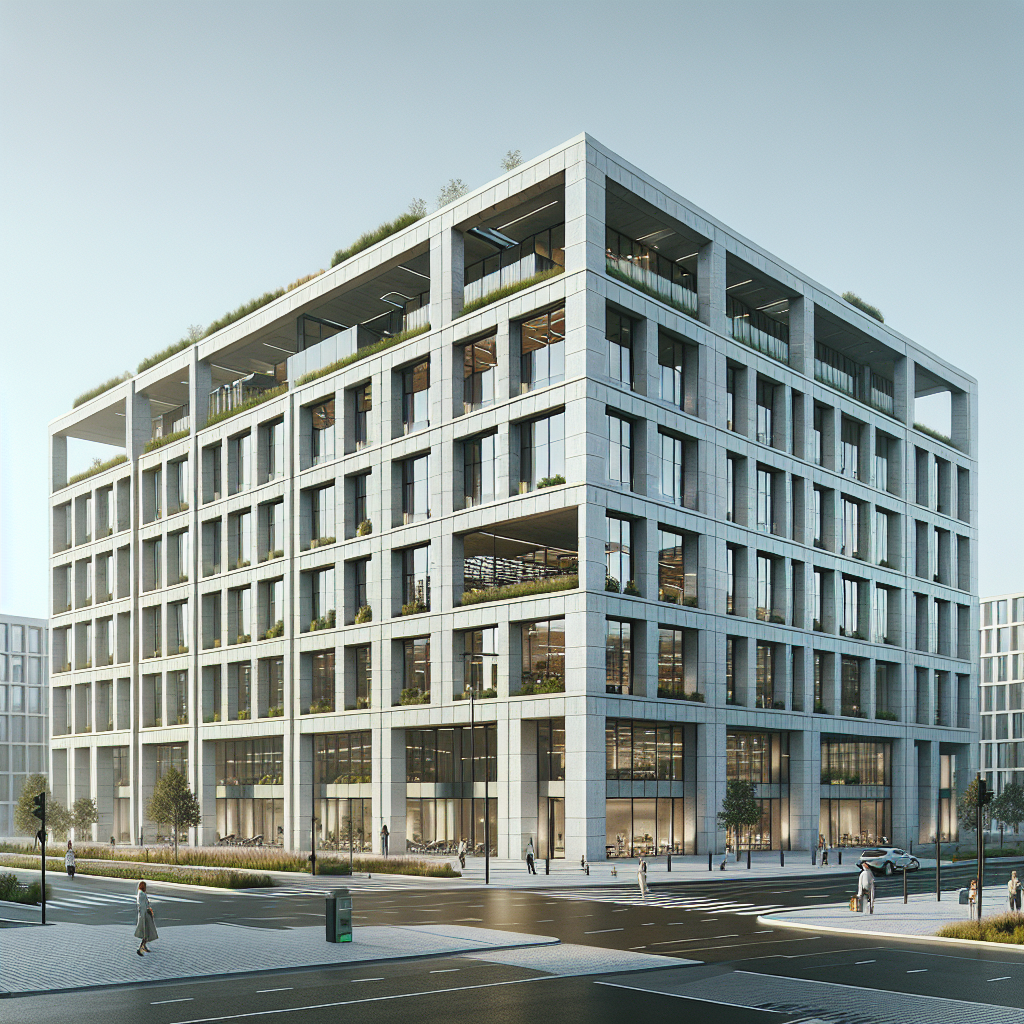
K7 Center Bubendorf – Strategic Business Location in the Basel Region
In the Basel region, commercial location decisions are rarely made on reputation alone. Companies and investors evaluate operating efficiency, accessibility for staff and clients, resilience of tenant demand, and long-term value preservation. Bubendorf, in the Waldenburg Valley (Basel-Landschaft), is increasingly relevant in this context: close enough to Basel for daily commuting, yet positioned in a submarket where space planning can be more pragmatic and scalable.
The K7 Center Bubendorf is a recently completed commercial building with a clear institutional profile. According to sitEX Properties, the building offers around 4,000 m² of lettable space and was completed in September 2024 (sitEX Annual Report 2024). Within a region shaped by strong life sciences, services, and a dense network of SMEs, K7 Center’s premise is straightforward: provide adaptable office and commercial space in a visible, accessible location, supported by an anchor tenant and a sustainable energy concept.
Core drivers: accessibility, flexibility, sustainability, and an anchor tenant
1) Visibility and transport connectivity
For many companies, “Basel proximity” is less about municipal borders and more about reliable commuting and predictable travel times. K7 Center is located directly on a busy cantonal road, offering strong visibility and road access (K7 Center Bubendorf). Public transport is equally relevant: the “Bad Bubendorf” station (Waldenburger-Bahn, line 19) is situated across the property, connecting the valley with Liestal and the city of Basel (K7 Center Bubendorf).
This combination matters for office users who want to attract talent from multiple catchment areas: Basel, Liestal, and the valley itself. In practical terms, it supports hybrid work patterns without making “car-only commuting” a structural requirement.
2) Flexible office layouts and scalable unit sizes
Office demand in Switzerland has shifted from purely “how many square meters” to “how well can the space evolve.” K7 Center positions itself explicitly as adaptable office space and offers several leasing configurations. The first floor can be rented as a full 2,200 m² area or as six independent units ranging from 152 m² to 623 m² (K7 Center information).
For occupiers, this flexibility reduces the risk of overcommitting to space. For investors, diversified unit sizes can broaden the prospective tenant pool, potentially improving absorption and limiting vacancy duration across market cycles.
- Single-unit strategy: Suitable for larger corporates or consolidated regional teams seeking operational coherence.
- Multi-unit strategy: Supports SMEs, satellite teams, project groups, or service providers with defined space requirements.
The building also offers a “core and shell” approach, with water, electricity, network connections and a hollow floor provided in the basic fit-out, allowing tenants to implement their own layout and specification within budget priorities (K7 Center information). In addition, the concept includes options for quicker occupancy with soon-to-be-ready offices (K7 Center information).
When discussing flexible workspace concepts more broadly, it is also worth differentiating between flexible office units (as offered at K7 Center) and coworking / serviced concepts that provide shorter terms and shared infrastructure. For regional context, coworking.p201.ch is an example of how flexible workspace models are being structured in Basel-Landschaft.
3) Sustainable energy concept and operating cost logic
Energy performance and operating costs are now part of office selection criteria, particularly for corporate tenants with ESG reporting obligations and for investors focused on long-term asset competitiveness. K7 Center states that it includes a sustainable energy concept with its own photovoltaic (PV) system, intended to reduce environmental impact and lower operational costs (K7 Center Bubendorf).
This aligns with the broader market direction in Switzerland: sustainable buildings are increasingly assessed not only on environmental merits, but on their ability to remain “lettable” as regulatory and tenant expectations evolve. In that sense, K7 Center is positioned as a sustainable office building in Switzerland with practical operational implications.
4) Anchor tenant effect: ALDI Suisse as a stability factor
Ground-floor retail can materially influence the perception and everyday functionality of a mixed-use commercial property. K7 Center’s anchor tenant is ALDI Suisse. The K7 project documentation highlights that the retailer is expected to create a steady flow of visitors (K7 Center Bubendorf).
From an institutional perspective, the anchor tenant element is also documented at group level: sitEX reports that ALDI Suisse moved in during the completion month, and that the building was already 50% let at completion (sitEX Annual Report 2024). For many office users, on-site or immediately adjacent retail reduces friction in daily routines; for property performance, it can support place-making and footfall consistency.
Practical relevance for businesses: what the location enables
Companies evaluating office space in Bubendorf often compare it against more established hubs closer to Basel city and the main transport axes. The practical question is whether the location supports the company’s operating model:
- Recruitment and retention: Public transport via Waldenburger-Bahn and proximity to Liestal broaden the commuter catchment without requiring a Basel city location (K7 Center Bubendorf).
- Client accessibility: Cantonal road visibility supports client-facing uses where wayfinding and presence matter.
- Space efficiency: Units from 152 m² to 623 m² (or 2,200 m² in total) allow matching space to real headcount, not just future assumptions (K7 Center information).
- Everyday functionality: Nearby restaurants, hotels, recreation routes, and retail (including the anchor tenant) support staff routines and visitor experience (K7 Center Bubendorf).
In addition, parking availability is often a decisive factor for valley locations. K7 Center references a dedicated parking garage with 64 spaces (K7 Center Bubendorf), which supports businesses with frequent visitors, service operations, or teams whose commutes are not fully rail-based.
For businesses comparing commercial locations in Basel-Landschaft, it can be useful to view K7 Center alongside other regional assets and workspace concepts. Depending on requirements, p201.ch represents another commercial location reference point in the broader region.
Long-term value perspective: resilience and asset logic
Long-term value in commercial real estate is typically supported by three factors: location durability, building adaptability, and tenant demand stability. K7 Center’s long-term profile benefits from several structural elements documented in the project and owner reporting:
- Recent completion: Completed in September 2024, the building enters the market with modern technical standards (sitEX Annual Report 2024).
- Anchor tenant and initial occupancy: 50% let at completion due to ALDI Suisse moving in (sitEX Annual Report 2024).
- Adaptable unit structure: Multiple unit sizes reduce reliance on a single tenant profile (K7 Center information).
- Energy concept: PV system contributes to sustainability positioning and operating cost logic (K7 Center Bubendorf).
Modern office demand is also shaped by evolving workplace concepts. In the Basel region, examples like the5thfloor.ch illustrate how office environments are increasingly designed around flexibility, amenities, and community elements. While K7 Center is a different product category than a coworking hub, it is influenced by the same underlying expectation: workspaces must adapt over time without forcing repeated relocations.
Positioning within Basel-Landschaft: Bubendorf as part of a multi-node economy
Basel-Landschaft is not a single-market story; it functions as an interconnected set of nodes: Basel as an international center, Liestal as a cantonal and service hub, and valley communities that combine residential quality with growing commercial relevance. Bubendorf sits within this system as a location that can support:
- Decentralized corporate functions (regional teams, support services, specialized units)
- SME growth requiring professional space standards without Basel city pricing structures
- Service providers benefiting from visibility and local accessibility
From an ownership and portfolio perspective, it is also relevant that K7 Center is part of a broader real estate platform. The sitEX group explicitly references its diversified portfolio and provides ongoing project and asset updates via sitex.ch (sitEX Annual Report 2024). For decision-makers, that context can be a credibility factor: properties managed within an institutional portfolio framework are often aligned with longer holding periods and structured asset stewardship.
For readers who want a direct overview of the property and its current positioning, the project website k7bubendorf.ch provides the primary reference point for K7 Center Bubendorf details.
Conclusion
K7 Center Bubendorf represents a pragmatic, modern approach to commercial property in the Basel region: a new building (completed in 2024), with documented scale (around 4,000 m²), an anchor tenant supporting baseline occupancy, and office configurations designed to accommodate different tenant sizes and growth trajectories (sitEX Annual Report 2024; K7 Center information).
As a business location in the Basel region, Bubendorf is not a substitute for Basel city; it is part of a broader economic geography in which companies increasingly balance accessibility, cost discipline, and staff expectations. For businesses, corporate tenants, investors, and regional stakeholders, K7 Center’s relevance lies in its logic: transport connectivity, adaptable space, sustainability measures, and the everyday functionality that supports long-term tenant satisfaction and asset resilience.